


Table of contents
Polycystic Ovary Syndrome (PCOS or micro-polycystic ovary syndrome) is a hormonal imbalance that affects nearly one in seven women worldwide. To learn more about PCOS, feel free to read our article "What is PCOS?"
If you have just been diagnosed, know that 1) you are not alone, and 2) you are in the best place to gather all the information you need to naturally improve your symptoms.
Are there really "TYPES" of PCOS?
Yes and no!
Symptoms of PCOS do not manifest in the same way in all women. While some struggle with weight, others are thin. Similarly, some suffer from excessive hair growth while others battle acne.
This clearly shows the diversity in PCOS symptoms. It is evident that it should not be approached the same way for all women. However, it can be difficult to determine a single type, as symptoms can check multiple boxes. That’s why at SOVA we prefer to talk about “areas of focus.”
💡 Tip: If you’re not sure which factors are impacting you most, try our free PCOS product quiz. It only takes 3 minutes and gives you personalised recommendations on the best supplements for your situation.
During the first consultation, a naturopathic professional will ask a variety of questions to assess the aggravating factors that exacerbate your PCOS symptoms. From there, they can determine the focus areas to effectively address your symptoms and improve your daily life.
We can identify 4 main factors + 1, but remember, they don’t always come together!
1. Insulin Resistance
About 70% of cases experience it. To explain how that works, let's start by defining insulin and its role.
Insulin is a hormone produced by the pancreas to regulate blood sugar levels. When we eat a meal, blood sugar levels rise and the pancreas secretes insulin to help sugar enter cells. It will then be used as energy.
However, in the case of insulin resistance, insulin loses activity, and sugar struggles to enter cells. Cells being less sensitive to insulin messaging, blood sugar levels remain high.
In order to compensate, the pancreas produces even more insulin, and this hyperinsulinemia goes on boosting ovarian androgen production. This leads to increased symptoms related to hyperandrogenism, such as lack of cycle, anovulation, excessive hair growth, hair loss, and acne.
Some clinical signs that might point you towards this are:
- Unexplained weight gain, especially around the abdomen
- Frequent sugar cravings sometimes leading to eating disorders
- Chronic fatigue with energy slumps after carbohydrate-rich meals
- Frequent urges to urinate
- Intense thirst
- Dark spots on the body
- Difficulty falling asleep even when exhausted
If you recognize these symptoms, don't hesitate to see your doctor for biological tests such as:
HOMA/QUICKI index, fasting insulin, fasting glucose, HbA1c (glycated hemoglobin), Oral Glucose Tolerance Test (including blood insulin levels).
💊 SOVA recommendation:
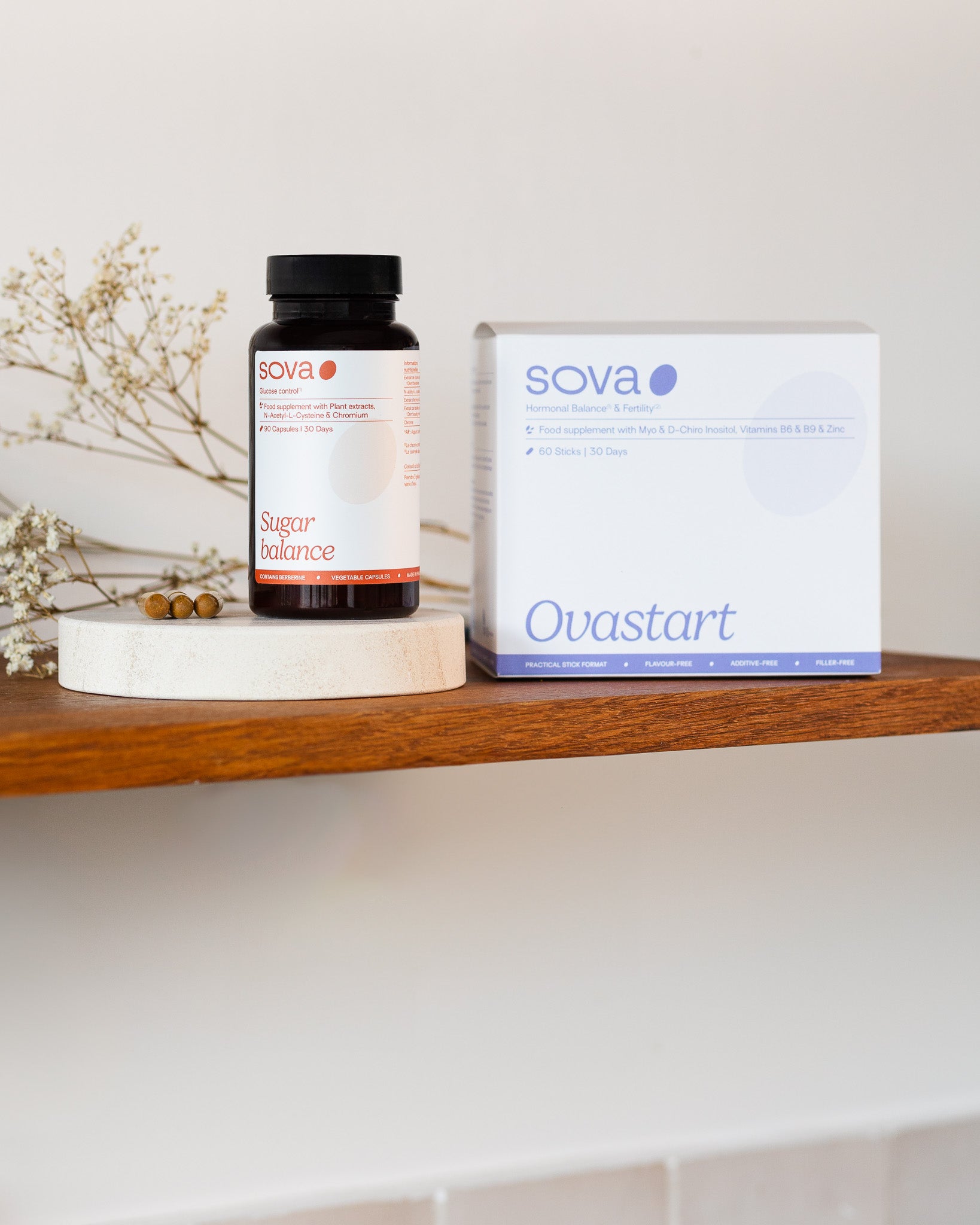
Sugar Balance is formulated with berberine, chromium, and zinc—scientifically studied ingredients that help support normal blood sugar levels and reduce cravings. For combined hormonal and metabolic support, try our Balance Bundle.

2. Adrenal Origin
The adrenal glands are two small glands located on top of the kidneys that produce cortisol (also known as “the stress hormone”) when we face a stressful situation, as well as androgens.
Cortisol helps us cope with stress, and its levels decrease once the stress factor is eliminated. However, modern life often stresses us on a daily basis and acute stress sometimes turns into chronic stress, leading to adrenal exhaustion.
Excessive stimulation of the adrenal glands leads to overproduction of androgens, worsening the hyperandrogenism found in women with PCOS.
Some clinical signs that might point you towards this are:
- Anxiety/depression
- Great difficulty managing stress, sometimes leading to panic attacks / tetany
- Fatigue upon waking, even after a good night's sleep
- Difficulty falling asleep or waking during the night
Wanna know more? Head out to our blog article dedicated to adrenal PCOS.
If you experience these symptoms and your cortisol and DHEA-S levels are abnormal, then you should learn how to manage your stress. If you need advice on this topic, don't hesitate to download our free Ebook which provides plenty of tips on the subject.
3. Chronic Inflammation
Chronic inflammation is increasingly suggested as the main cause of PCOS (although this still needs to be formally proven). This inflammation could promote the development of insulin resistance which, in turn, would feed inflammation, creating a real vicious circle!
Inflammation is a normal body reaction to protect itself against external aggressions like injuries, viruses, bacteria, cancer cells. However, women with PCOS tend to have low-grade chronic inflammation which also contributes to the overproduction of androgens and the development of insulin resistance.
It has been shown that, compared to a same weight woman, one with PCOS has higher inflammatory markers due to various reasons: smoking, alcohol, food intolerances, a diet high in pro-inflammatory foods, vitamin and mineral deficiencies, endocrine disruptors, etc.
Some clinical signs that might point you towards this are:
- Joint pain
- Frequent headaches
- Digestive disorders
- Painful cystic acne
Testing inflammatory markers such as CRP (C-reactive protein) and sedimentation rate can be useful indicators.
Wanna know more? We have an article talking about inflammatory PCOS in details.
💊 SOVA recommendation: Pair Ovastart with anti-inflammatory dietary changes to support ovarian health and hormone regulation.

4. Hypothyroidism
The thyroid is a small butterfly-shaped gland at the base of the neck and it essentially acts as the conductor of our body! Thyroid hormones affect many aspects: basal metabolism, body temperature, weight, muscle strength, appetite, reproductive and cardiovascular systems, etc.
So, a small thyroid imbalance causes a multitude of symptoms affecting the whole body.
Hypothyroidism is when this small gland produces fewer hormones, slowing down our body’s functions. This will have a direct effect on reproductive function and can often cause ovulation disorders.
Several studies have been conducted on the link between hypothyroidism and PCOS, and it has been determined that about 22% of those affected by PCOS have associated Hashimoto’s thyroiditis.
Some clinical signs that might point you towards this are:
- Fatigue
- Unexplained weight gain
- Hair loss
- Brittle nails
- Memory problems
- Loss of libido
- Sensitivity to cold/heat
- Heart rhythm disorders
- Depression
If you recognize these symptoms, don't hesitate to consult your doctor for a thyroid hormone analysis: TSH US, T4, T3, and antibodies. Also, you can take a look at our blog article on PCOS and Hypothyroidism.
A Special Case: Post-Pill Syndrome
There are increasingly reported cases of PCOS occurring after stopping the pill, but for many, it will only be temporary.
While on the pill, ovulation is blocked, and natural hormones are replaced by much higher-dosed synthetic ones. When stopping the pill, especially after several years, the body may struggle to readjust leading to a rebound effect!
It is not uncommon to see signs of PCOS such as lack of menstruation, acne, excessive hair growth, and hair loss. The body may take some time to eliminate synthetic hormones so patience is key!
Could it be something else than Polycystic Ovary Syndrome?
Several conditions can mimic the symptoms of PCOS, such as:
- Hypothalamic amenorrhea
- Hyperprolactinemia
- Congenital Adrenal Hyperplasia
- Hypothyroidism (it can be associated with PCOS but can also block ovulation on its own)
This is why it is important to make an appointment with your doctor to rule out other causes.
✅ Next step: Take our free product quiz to discover the best SOVA products for your symptoms and goals.
🛒 Browse our PCOS supplements for targeted hormonal and metabolic support.
We hope this article helps clarify things for you!
Have a great day 🥰
- PCOS types : A way of classifying PCOS based on the dominant underlying mechanism (metabolic, inflammatory, adrenal, etc.). While not official medical diagnoses, these categories help better understand symptom patterns and tailor management.
- Insulin-resistant PCOS : The most common type of PCOS, characterised by insulin resistance and elevated insulin levels, which stimulate excess androgen production and disrupt ovulation.
- Inflammatory PCOS : A form of PCOS associated with chronic low-grade inflammation, often linked to gut health issues, food sensitivities or environmental stressors.
- Adrenal PCOS : A PCOS type where excess androgens are primarily produced by the adrenal glands rather than the ovaries, often associated with chronic stress.
- Post-pill PCOS : A temporary PCOS-like presentation that may appear after stopping hormonal contraception. Symptoms usually improve as the hormonal axis rebalances.
- Androgens : Hormones such as testosterone and DHEA that are naturally present in women but may be elevated in PCOS, contributing to acne, hair growth or hair loss.
- DHEA-S : An androgen produced mainly by the adrenal glands. Elevated levels may suggest adrenal involvement in PCOS.
- Chronic inflammation : A persistent, low-grade inflammatory state that can interfere with hormone signalling, insulin sensitivity and ovarian function.
- Hormonal axis : The communication system between the brain, ovaries and adrenal glands that regulates hormones, ovulation and stress response.
SOVA was created by two sisters with PCOS who wanted products that truly worked. Our formulas are developed in-house with women’s health and micronutrition experts, using ingredients backed by clinical studies and compliant with European regulations.
- Built by women with PCOS, we know the reality of the symptoms.
- Clinically studied, high-quality ingredients, including patented forms like Quatrefolic® and an optimal Myo-/D-Chiro Inositol ratio.
- Holistic support for hormonal balance, metabolic health, inflammation, mood and cycle regulation.
- Transparent, science-led formulas with no unnecessary additives.