




Sugar Balance
Berberine Supplement UK - Blood Sugar, Insulin & Metabolic Support for Women with PCOS
From £26

The Balance Bundle
The Hormone Balance Supplements Built for PCOS - Two Products, One Complete System
From £53
Table of contents
- 01. Key Takeaways
- 02. The Two Definitions of Disability: Which One Do You Need?
- 03. Recognising the Condition: What Are the First Signs of PCOS?
- 04. PCOS and the ADA: Your Rights in the Workplace
- 05. Qualifying for SSA Disability Benefits with PCOS
- 06. The Medical Evidence Checklist: Building Your Case
- 07. FAQ: Your Questions Answered
- 08. Conclusion: Taking the Next Steps
- 09. Key Terms
If you're living with PCOS, you already know it's so much more than an "irregular period." It can mean debilitating pain, exhausting fatigue, relentless anxiety, and days when getting out of bed — let alone making it to work — feels like a real challenge. And yet, many women with PCOS feel dismissed, as if their suffering isn't "serious enough" to warrant real support.
Here's what's important to know: your pain is real, it is documented by science, and in many cases, the law is on your side.
Key Takeaways
- PCOS can legally qualify as a disability, depending on how it affects your daily life.
- In the United States, two separate legal frameworks apply: the ADA (protecting your rights at work) and the SSA (providing financial benefits if you cannot work).
- PCOS is not listed on its own in official disability registers, but its symptoms and related conditions often meet the legal criteria.
- Building your case starts with documentation — and this guide will show you exactly what to gather.
The Two Definitions of Disability: Which One Do You Need?
Before asking "is PCOS a disability?", it's worth asking: what kind of support are you looking for? There are two very different legal paths, and they serve different purposes.
|
Feature |
ADA — Workplace Rights |
SSA — Disability Benefits |
|
Goal |
Keep your job with the right adjustments |
Receive financial support if you can't work |
|
Eligibility |
A condition that substantially limits a major life activity |
An inability to perform substantial work for 12+ months |
|
Outcome |
Reasonable accommodations at work |
Monthly disability payments |
The Americans with Disabilities Act (ADA) is not about whether you can work — it's about making sure your workplace supports you so that you can. The Social Security Administration (SSA), on the other hand, steps in when your condition makes it impossible to work at all.
Knowing which path is right for you is the first step. Many women with PCOS find the ADA route more accessible, while others — particularly those with severe metabolic, neurological, or mental health complications — may qualify for SSA benefits.
Recognising the Condition: What Are the First Signs of PCOS?
The first signs of PCOS usually include irregular or absent periods, excessive hair growth on the face or body, persistent acne, and difficulty managing weight. These symptoms typically begin in the late teens or early twenties, driven by elevated androgen levels — though many women are not diagnosed until much later.
PCOS is one of the most common hormonal disorders affecting women during their reproductive years. According to the World Health Organization (WHO), it affects an estimated 10–13% of women of reproductive age worldwide — and shockingly, up to 70% of those affected don't even know they have it.
The condition doesn't look the same for everyone. For some women, it shows up primarily as irregular cycles and fertility challenges. For others, it means daily fatigue, chronic pain, low mood, blood sugar imbalances, and a significant reduction in quality of life. Research confirms that PCOS affects not only physical health but also emotional wellbeing, with measurable impacts on self-esteem, social functioning, and the ability to carry out everyday tasks.
Other symptoms that may accompany PCOS include:
- Heavy or painful periods
- Difficulty concentrating or "brain fog"
- Chronic fatigue
- Sleep disturbances
- Hair thinning or loss on the scalp
- Skin darkening (acanthosis nigricans)
- Mood swings, anxiety, or depression
To find out more about what PCOS is, read our guide to what is PCOS.

PCOS and the ADA: Your Rights in the Workplace
Under the Americans with Disabilities Act, a disability is defined as any physical or mental impairment that substantially limits one or more major life activities — things like sleeping, concentrating, regulating your mood, managing your physical health, or performing manual tasks.
PCOS, by this definition, can absolutely qualify. The ADA does not require a specific diagnosis to appear on a list — it looks at how your condition affects you. If your PCOS causes fatigue that impairs your ability to concentrate, pain that limits your mobility, or anxiety that affects your interactions with colleagues, you may well meet the standard.
What Qualifies as a "Reasonable Accommodation" for PCOS?
A reasonable accommodation is any adjustment to your work environment or schedule that allows you to do your job effectively. For women with PCOS, these might include:
- Flexible start times, to accommodate mornings made difficult by fatigue, pain, or medication side effects
- Remote working options, particularly during flare-ups or heavy periods
- Proximity to bathroom facilities, for women with heavy bleeding or digestive symptoms
- Scheduled breaks, to take medication, eat regularly (important for blood sugar regulation), or manage pain
- Reduced workload or adjusted deadlines during particularly severe symptom periods
- A private space, for pumping, resting, or managing medical needs discreetly
These are not privileges — they are legal entitlements, provided your condition is documented and communicated appropriately.
How to Disclose Your Condition to HR
Disclosing a medical condition at work can feel daunting, especially when PCOS is a condition that is so often misunderstood. You do not need to share every detail. Here is a simple, professional way to frame the conversation:
"I have a chronic medical condition called polycystic ovary syndrome (PCOS) that is managed with treatment, but which can affect my [energy / concentration / attendance] on certain days. I'd like to discuss what reasonable adjustments might help me continue to perform well in my role."
You are entitled to keep the specifics private. Your employer is required to engage with your request in good faith — they do not have the right to dismiss it without consideration.
Qualifying for SSA Disability Benefits with PCOS
The Social Security Administration (SSA) runs two programmes that can provide financial support if you are unable to work: Social Security Disability Insurance (SSDI) and Supplemental Security Income (SSI). To qualify, you generally need to demonstrate that your condition prevents you from performing substantial gainful activity, and that this limitation is expected to last at least 12 months.
Why the SSA "Blue Book" Doesn't List PCOS
The SSA's "Blue Book" — its official list of qualifying conditions — does not include PCOS as a standalone entry. This is not because PCOS isn't serious. It's because PCOS is a syndrome: a collection of symptoms and related conditions rather than a single, clearly-defined disease with uniform presentation.
This means that PCOS alone is rarely sufficient to obtain SSA disability benefits. But — and this is important — PCOS rarely exists alone.
Top Qualifying "Related Conditions": The Combination Effect
The SSA evaluates your total functional picture. PCOS frequently co-occurs with other conditions that do appear in the Blue Book or are otherwise recognised by the SSA. These include:
- Type 2 diabetes / insulin resistance: Women with PCOS are significantly more likely to develop metabolic complications, including type 2 diabetes, which is a recognised SSA condition.
- Depression and anxiety: Research consistently shows that women with PCOS experience dramatically higher rates of depression and anxiety than women without the condition. One large meta-analysis found that women with PCOS had nearly four times the odds of experiencing moderate to severe depressive symptoms compared to those without PCOS. These mental health conditions, when clinically significant, are themselves qualifying conditions.
- Sleep apnoea: A well-documented comorbidity of PCOS, particularly in women with metabolic syndrome.
- Endometrial hyperplasia or cancer: A longer-term risk associated with PCOS that may qualify independently.
- Chronic pain syndromes: Including those related to inflammation and hormonal dysregulation.
The key is to build a case that shows how your specific combination of symptoms and conditions limits your ability to work.
To learn more about how insulin resistance connects to your PCOS symptoms, read our guide to insulin resistance and PCOS — what's the link.

The Medical Evidence Checklist: Building Your Case
Whether you're pursuing ADA accommodations or SSA benefits, your medical documentation is everything. Here is what to gather:
The PCOS Medical Evidence Kit
- PCOS diagnosis letter from your gynaecologist or endocrinologist, citing the diagnostic criteria used (e.g. Rotterdam criteria)
- Hormone panel results: androgens (testosterone, DHEAS), LH/FSH ratio, AMH, insulin, and fasting glucose
- Ultrasound imaging showing polycystic ovarian morphology
- Records of related diagnoses: insulin resistance, depression, anxiety, sleep apnoea, etc.
- Medication history: treatments tried, current prescriptions, side effects that impact functioning
- Specialist letters: from your gynaecologist, endocrinologist, mental health provider, or GP, specifically addressing how symptoms limit your daily functioning
- A symptom diary: ideally kept over several months, noting which days were difficult and why — this personal record can be surprisingly powerful
Proving "Functional Limitations": It's Not About the Diagnosis
One of the most important things to understand about SSA disability claims is this: the SSA does not award benefits based on diagnosis alone. It looks at what you can and cannot do.
This is assessed through what's called a Residual Functional Capacity (RFC) evaluation. An RFC essentially asks: given all of your symptoms and conditions combined, what kind of work (if any) are you still capable of doing?
For women with PCOS, the symptoms most likely to support a strong RFC claim include:
- Severe fatigue that prevents sustained concentration or physical activity
- Chronic pelvic pain that limits your ability to sit, stand, or move for extended periods
- Cognitive difficulties ("brain fog") that impair memory, focus, or decision-making
- Significant depression or anxiety that makes it difficult to interact with colleagues or manage workplace stress
- Frequent medical appointments that disrupt work attendance
The more clearly and specifically these functional limitations are documented — by you and by your medical team — the stronger your case will be.
FAQ: Your Questions Answered
Is PCOS a chronic illness or a disability?
PCOS is both. It is a lifelong hormonal condition — meaning it is chronic by definition. Whether it qualifies as a legal disability depends on how significantly it affects your daily life and ability to function. Under the ADA, PCOS can meet the definition of disability if it substantially limits a major life activity. Under the SSA, it is more likely to qualify when paired with related conditions that collectively prevent you from working.
Can you claim disability if you have PCOS?
Yes, it is possible — but it depends on the severity of your symptoms and your specific circumstances. PCOS alone is rarely sufficient for SSA disability benefits, but when combined with related conditions such as type 2 diabetes, significant mental health disorders, or severe metabolic complications, a successful claim is very achievable. For ADA workplace accommodations, the threshold is lower, and many women with PCOS qualify.
Does PCOS qualify for FMLA?
The Family and Medical Leave Act (FMLA) allows eligible employees to take up to 12 weeks of unpaid, job-protected leave per year for a serious health condition. PCOS, particularly when it involves incapacitating symptoms, hospitalisations, or ongoing treatment, can qualify as a "serious health condition" under FMLA. You will typically need documentation from your healthcare provider confirming that your condition requires ongoing treatment or causes periods of incapacity.
Conclusion: Taking the Next Steps
If you've read this far, you may be feeling a mixture of things — perhaps relief that your experience is validated, or perhaps overwhelm at the steps ahead. Both are completely understandable.
The most important thing is this: you do not have to navigate this alone. Whether you're looking to request workplace accommodations, explore disability benefits, or simply better understand your rights, the right professional guidance can make an enormous difference.
Start by:
- Consulting a healthcare professional to discuss documentation of your symptoms and any related conditions
- Speaking with an employment lawyer or disability advocate, particularly if you're pursuing SSA benefits or facing resistance at work
- Building your medical evidence file using the checklist above
Your symptoms are real. Your struggles are valid. And you deserve support — in every sense of the word.
Key Terms
ADA (Americans with Disabilities Act): US legislation that protects people with disabilities from discrimination at work and requires employers to provide reasonable accommodations.
SSA (Social Security Administration): The US federal agency that administers disability benefit programmes, including SSDI and SSI.
RFC (Residual Functional Capacity): An SSA assessment of what tasks a person is still able to perform despite their medical conditions.
FMLA (Family and Medical Leave Act): US legislation allowing eligible employees to take unpaid, job-protected medical leave.
Reasonable Accommodation: An adjustment to a job or workplace that enables a person with a disability to perform their role effectively.
Rotterdam Criteria: The most widely used diagnostic criteria for PCOS, requiring at least two of the following three features: irregular ovulation, elevated androgen levels, and polycystic ovarian morphology on ultrasound.
Androgens: Hormones such as testosterone that, when elevated in women with PCOS, drive symptoms including acne, excess hair growth, and irregular periods.
Insulin Resistance: A metabolic condition common in PCOS in which the body's cells respond less effectively to insulin, contributing to weight gain, fatigue, and elevated diabetes risk.
Scientific references
SOVA was created by two sisters with PCOS who wanted products that truly worked. Our formulas are developed in-house with women’s health and micronutrition experts, using ingredients backed by clinical studies and compliant with European regulations.
- Built by women with PCOS, we know the reality of the symptoms.
- Clinically studied, high-quality ingredients, including patented forms like Quatrefolic® and an optimal Myo-/D-Chiro Inositol ratio.
- Holistic support for hormonal balance, metabolic health, inflammation, mood and cycle regulation.
- Transparent, science-led formulas with no unnecessary additives.


High-purity DHA & EPA for real hormonal support


Hormone balance + essential fatty acids
Berberine Supplement UK - Blood Sugar, Insulin & Metabolic Support for Women with PCOS
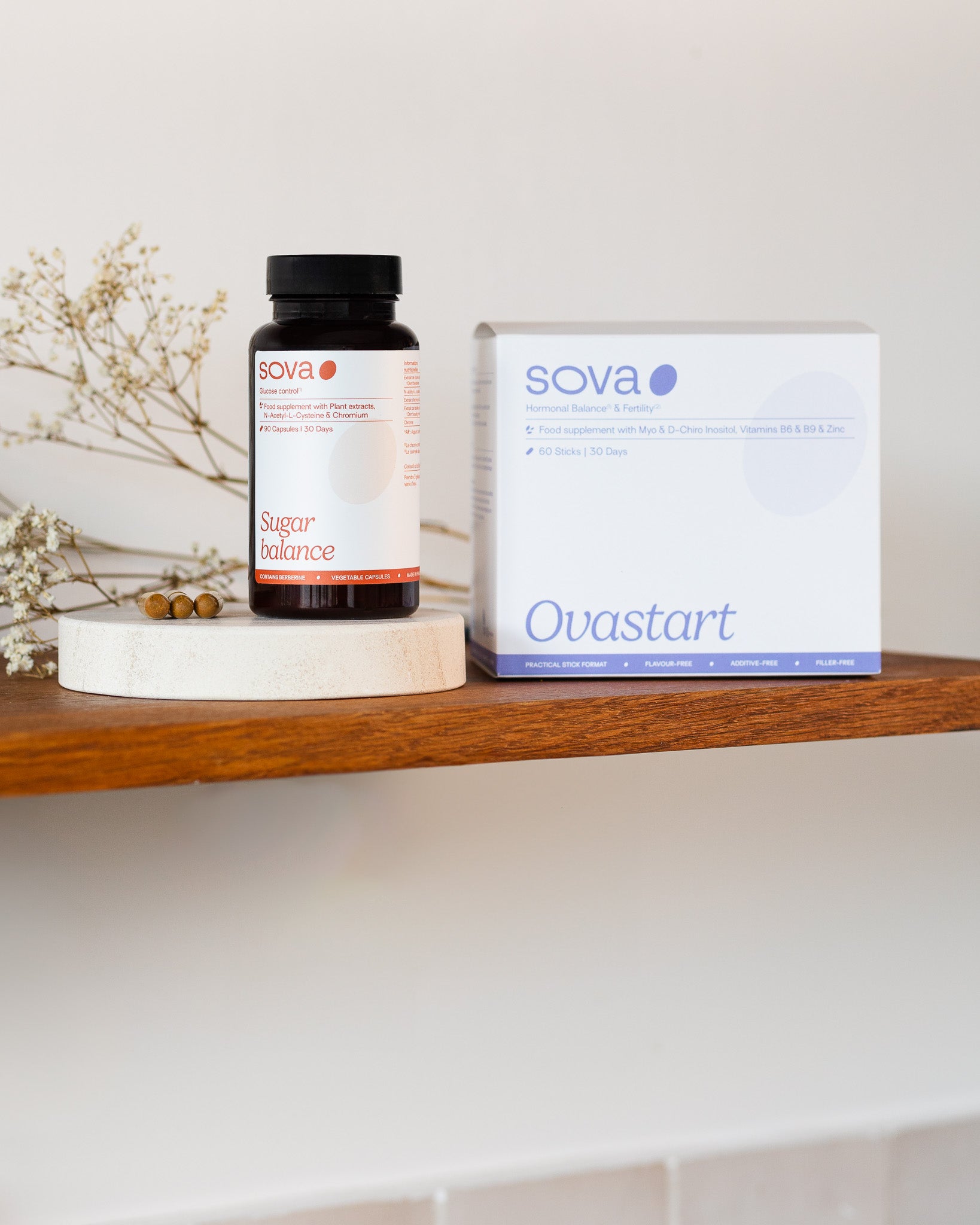
The Hormone Balance Supplements Built for PCOS - Two Products, One Complete System